
Abel Corver
Hello! I am a PhD candidate in the Department of Neuroscience at Johns Hopkins University, and a member of the Gordus Lab in the Department of Biology.
My research interests revolve around understanding how circuits in the brain give rise to cognitive behavior, ranging from language, to navigation and currently web-making.




Click here for Norbert Corver's Homepage!
Can small brains answer big questions about the neuroscience of cognition?
To succeed in their environment, all animals choose their actions based on their perception of the world. For example, upon accidentally touching a hot surface, our hand reflexively retracts. Despite the importance of such reflexes, purely reflexive behavioral strategies can be limiting: For example, if an ant were to use a purely reflexive visual strategy to navigate towards its nest, it would lose its way if the nest were temporarily hidden from view by an object. In reality, virtually all animals — flies, ants, mice, and we ourselves — are able to extend their reasoning beyond the present moment. Unconsciously, at every moment in time, we build internal models of the world and engage in sequences of thoughts that are decoupled from the timing of events in the external environment. Such internal processes are mediated by internal states — that is, forms of memory. A process that is mediated by internal states and therefore not purely reflexive is called “cognitive,” and such processes collectively are called “cognition.”
Despite the enormous importance of cognition to human language, animal navigation, etcetera, relatively little is understood about how individual brain cells implement these internal state processes. This is in contrast to more reflexive behaviors — such as navigating towards the highest concentration of odor or food — for which detailed neural circuits have been discovered at a greater pace. In my view there are at least three reasons for this:
- Internal states are harder to define behaviorally because they are invisible.
- The networks of brain cells implementing these cognitive states are several steps removed from sensory neurons and muscle cells, and are therefore more distributed and more difficult to record from.
- Historically, animals with small brains were not often thought to possess cognitive behaviors, and were instead
thought of as “reflex machines.” This limited study of cognition to animals with larger brains —
such as rodents, monkeys and humans — where the relevant brain cells are more difficult to find.
In neuroscience, often one is looking for a needle in a haystack, and larger brains are significantly larger haystacks.
Recent years have seen an increasing appreciation for the cognitive aspects of behaviors exhibited by small animals such as insects and arthropods. Simultaneously, technical advances now often make it possible to record from large number of brain cells anywhere in the brains of these small animals.
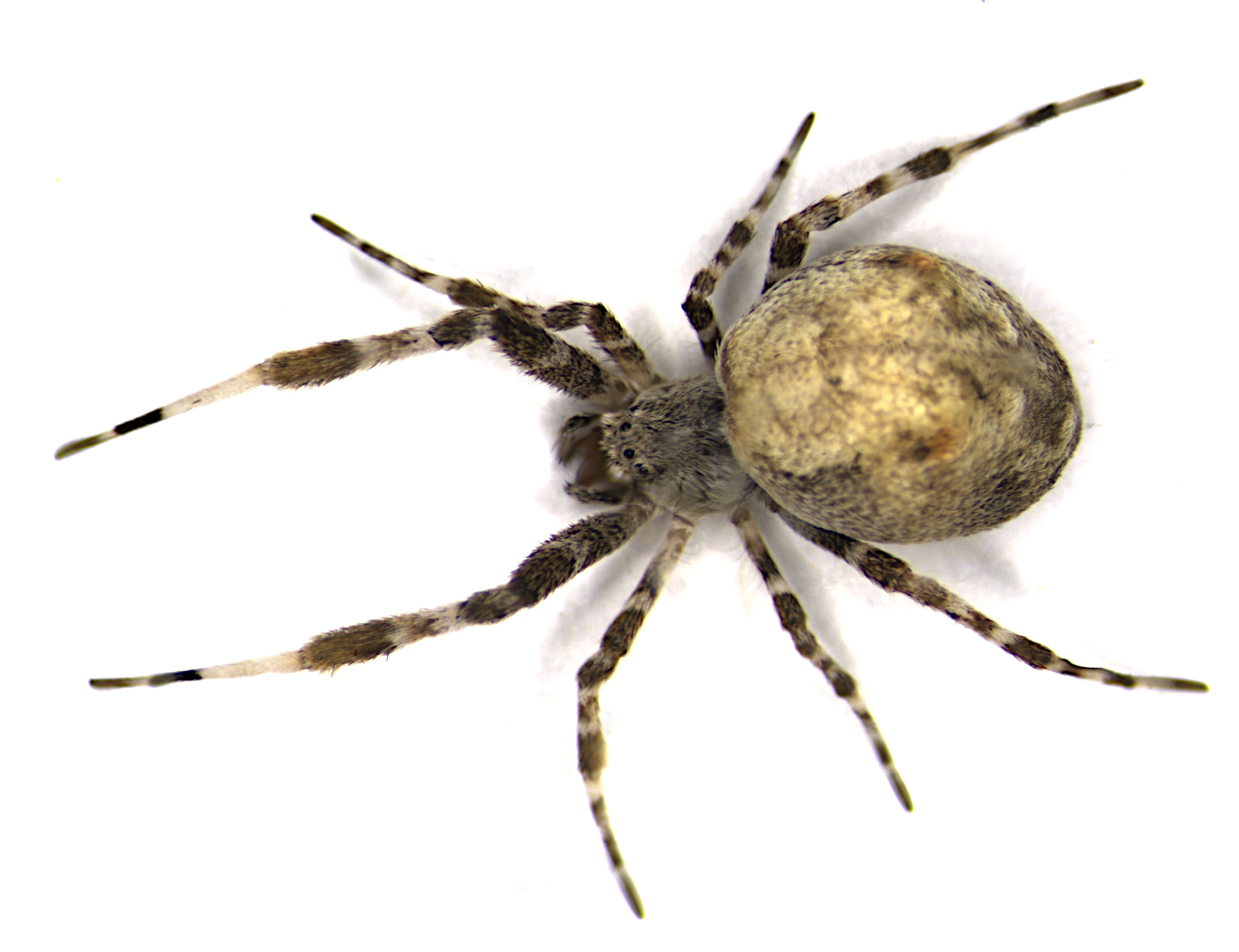
The web-making of the spider Uloborus diversus is a perfect example of the complexity of behavior exhibited by even the smallest brains. These spiders have an estimated 500,000 neurons, about 200,000 times fewer than our own ~90,000,000,000. Yet, they produce beautiful geometric structures over the course of several hours, completely in the dark! Furthermore, the robustness of their behavior in the face of variability encountered in their environment suggests that they are not using a purely reflexive strategy. In the Gordus Lab, I am currently investigating the structure of this web-making behavior, and am developing techniques to record from their brain. Read more about our spider research here!
More broadly, I believe understanding cognition in large brain such as our own will require a prior understanding of the toolkit of “building blocks” that brains use to implement various computational operations. I therefore believe that the study of small brains — such as those of arthropods — will be essential to answering the biggest questions in neuroscience and cognitive science in general.
Research Interests
My research interests include:

Development of experimental assays and models for cognitive behaviors
Physiology of cognitive neural circuits
Linguistics and (developmental) psychology as a source of questions and inspiration in the study of small model organisms
Spider web-making as a model for
complex, cognitive behavior.
The spider Uloborus diversus is an orb-weaver native to California and Arizona. Its web-making behavior is highly stereotyped and structured across multiple timescales, thus raising the possibility of cognitive, internal-state driven control of its behavior. Possessing on the order of 500,000 neurons, U. diversus offers a tractable model organism for studying cognitive behaviors in identified, near-complete circuits and cell types. In my research, I am building behavioral models characterizing the decision-making rules and potential internal states used by the spider during web-making. In addition, I am building tools to record from relevant neurons in the brain of this spider to directly probe the neural correlates of behaviors on the web. These projects are highly collaborative, so please visit the Gordus Lab website to meet the rest of the team!
A significant and fascinating body of work exists on the behavior of spiders. However, due to technical difficulty, and the fact that much work on spiders is done in the field, little work exists capturing both the movements of the spiders and the evolving structure of the web simultaneously. We have developed a novel assay using alternating light sources that now allows us to capture both the spider and its sensory environment (that is, the web) simultaneously. This gives us a unique ability to model the dynamic decision-making structure underlying web-making, and its sensory, motor, and internal state components.
To characterize the neural underpinnings of this behavior, we are developing functional calcium imaging protocols in the spider. Ultimately, we aim to investigate neural coding underlying the spider’s complex behavior on its web.